How to identify a spider
The Short Answer
To identify a spider, I start with four simple clues: body shape, markings, eye arrangement, and web type before trying to decide the species or exact family.
In my experience, a quick look at the body, shape, and web can usually place a spider into a group such as a wolf spider, orb weaver, jumping spider, or cobweb spider, while an exact species often needs a magnified look at the eyes because spider taxonomy can be complex.
There are thousands of spider species across the United States, with around 3,500 spider species recorded, but only two groups are considered medically significant: widow spiders and recluse spiders.
Most spiders you find in a bathroom or home are simply a nuisance rather than a danger, and checking the state where the spider was found can make identification much easier.
The 60-Second Workflow
Two body parts and a waist? → It’s a spider.
Is it in a web, or running? → Running means a hunter. Hunters are near-universally harmless.
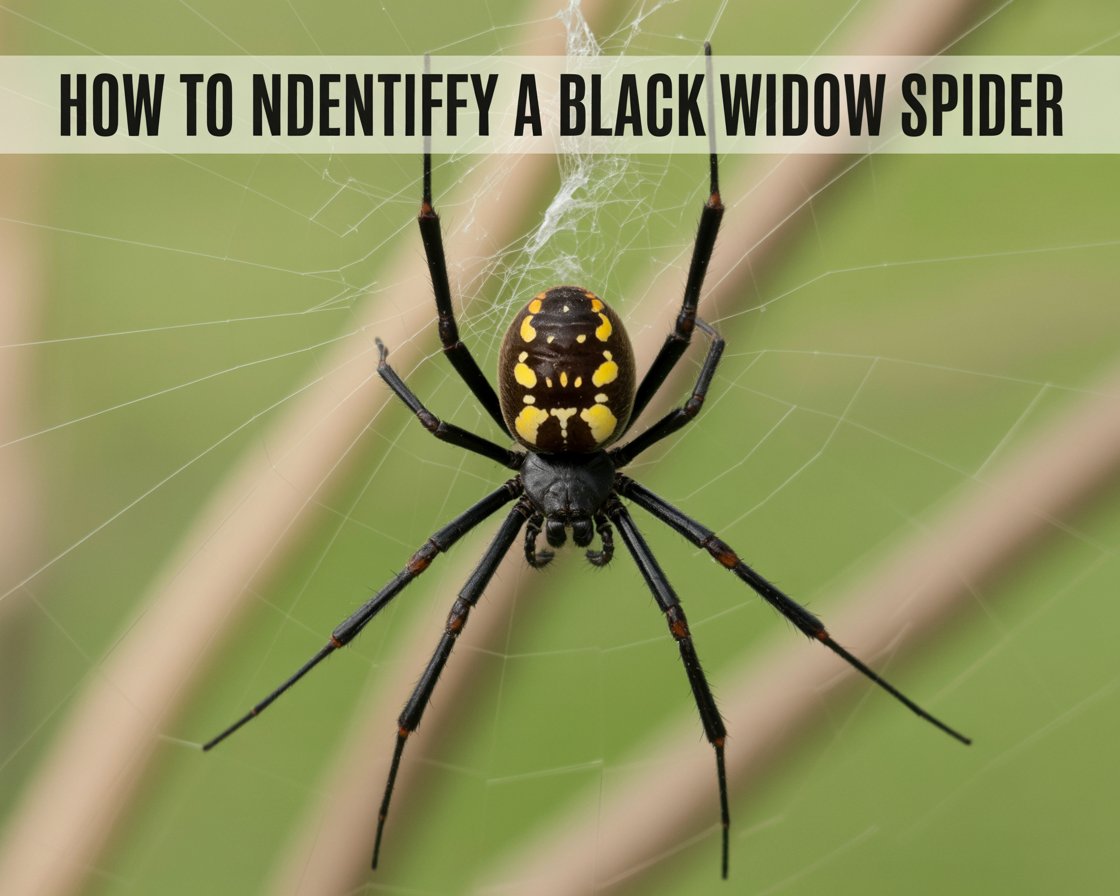
Look at the abdomen. Glossy black and globe-shaped? Check underneath for an hourglass.
Look at the legs. Banded or spiny? Not a recluse. Done.
Check the web shape. Orb, funnel, sheet, tangle, or hidden retreat.
Check your state. If the species doesn’t live there, the ID is wrong.
Photograph it properly — top, side, wide shot, scale — and run it through an identifier or post it to a community ID board.
Who This Guide Is For
This guide is for anyone trying to identify a spider, whether you are reading this page at 11 p.m. with a phone flashlight pointed at a corner of the ceiling or simply searching for how to identify a spider.
It is not only for entomology students but also for homeowners, renters, gardeners, hikers, iNaturalist users, and parents helping with a science project.
If your kid sleeps nearby and you need a fast answer about whether this thing is dangerous, this guide provides panic answers first while teaching the real method to understand spider differences beyond a simple yes/no.
Step 1: Confirm It’s Actually a Spider
Before you identify the species, first confirm you are looking at a spider because many spiders people photograph are actually something else.
A spider has two body segments: the cephalothorax (the fused head-and-chest) and abdomen, connected by a narrow waist, with eight legs attached to the cephalothorax, spinnerets as finger-like structures at the rear of the abdomen, chelicerae or fangs, and pedipalps as short leg-like structures.
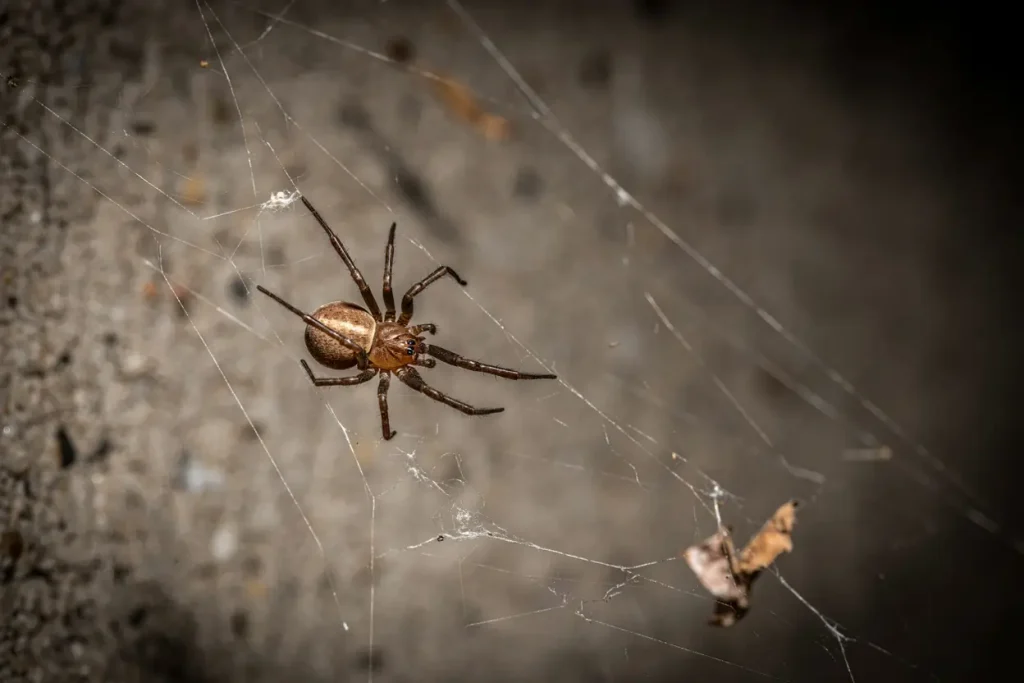
Unlike an insect with three body segments, six legs, antennae, and often wings, a harvestman or daddy longlegs has a single oval body on stilts, no visible waist, and no silk or venom glands.
A cellar spider in the basement is different because it has a distinct two-part body and builds a messy web. The quick test: if it has a visible waist and is sitting in silk, it is likely a spider.
Step 2: How to Identify a Spider by Its Markings
Spider identification often begins with the most-searched angle of the topic: markings.
In my experience, color and pattern are a useful clue and starting clue, but never the final verdict because they can show variation within the same species due to age, sex, molt stage, or even spider diet after it has recently ate.
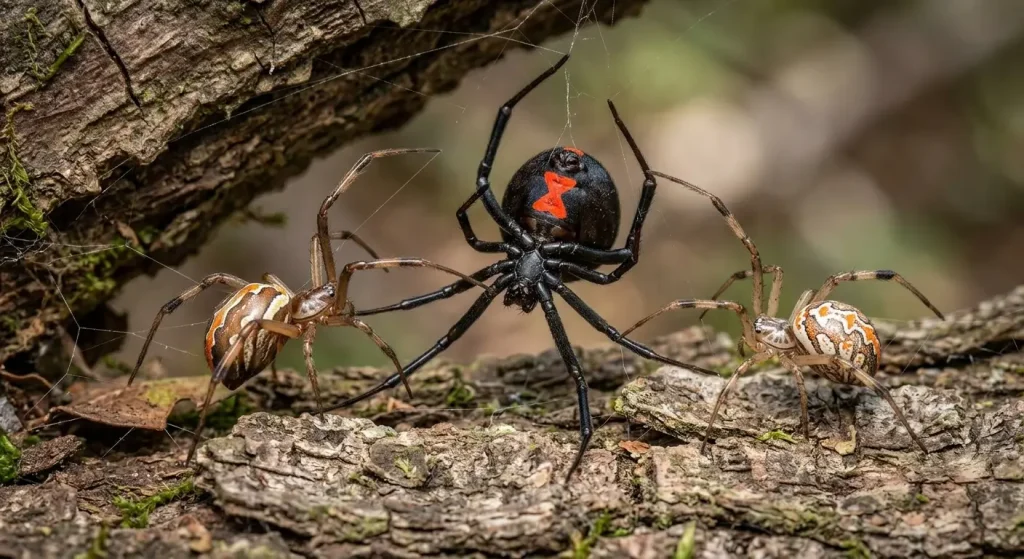
For example, male black widows, female black widows, juvenile widows, and adult spiders can look completely different, so markings should guide your search rather than decide the answer alone.
That said, here’s what markings can reliably tell you:
Markings worth trusting:
| Marking | What it usually means |
| Red or orange hourglass on the underside of a shiny black, globe-shaped abdomen | Black widow (Latrodectus) |
| Faint orange hourglass on a tan/gray abdomen with lateral stripes | Brown widow |
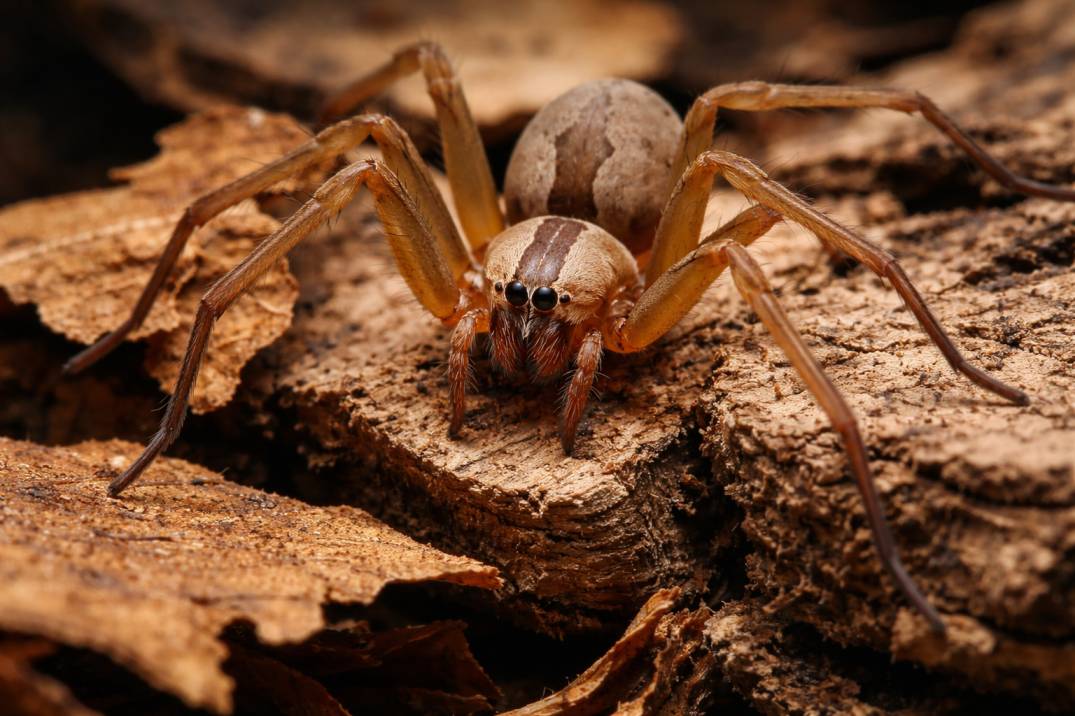
| Dark violin shape on the cephalothorax plus six eyes and unbanded legs | Possible brown recluse — see the checklist below |
| Chevron or V-shaped “sergeant’s stripes” on the abdomen | Funnel weaver / hobo spider group |
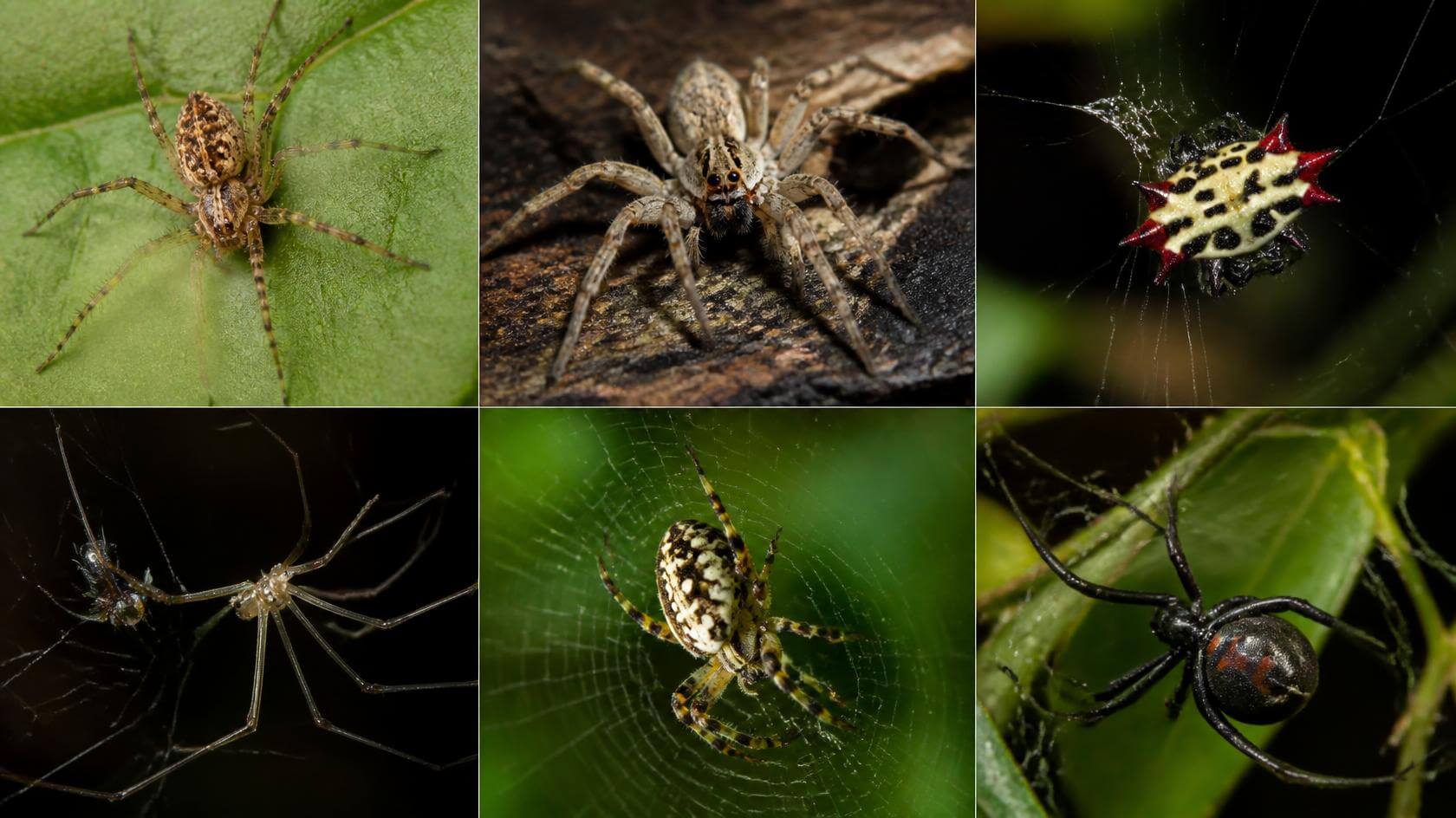
| Two dark stripes running lengthwise down the cephalothorax | Wolf spider |
| Crab-like spines sticking out from the sides | Spiny-backed orb weaver |
| Bright yellow-and-black with a zigzag ribbon in the web | Yellow garden spider (Argiope) |
Markings that mislead people constantly:
- A common mistake in spider identification is assuming every brown spider with a dark blotch is a violin marking or a recluse. In reality, color, markings, and the abdomen pattern are only an identification clue, not proof.
- Banded legs and striped legs are an instant signal that the spider is not-a-recluse, because recluses do not have these patterns.
- A true recluse has a uniformly colored abdomen and does not have two-tone abdomens or multiple pigments on the body.
If you’re describing the spider to someone rather than showing them, describe it in this order: body length excluding legs → abdomen shape → leg banding → cephalothorax pattern → web type → what state you’re in. That’s the sequence an arachnologist actually needs.
Step 3: Read the Eyes (The Feature Pros Actually Use)
Spiders are formally identified through eye arrangement, including the number of eyes, eye layout, and rows they appear in.
With magnification using a jeweler’s loupe, phone macro lens, or clip-on macro attachment, this is often the fastest way to separate a scary-looking spider from a medically significant spider.
Most have eight eyes in two rows of four, while some have six eyes or fewer eyes. Eye patterns like forward-facing eyes with smaller eyes identify a jumping spider (Salticidae), which is curious, hops, watches you back, and is harmless.
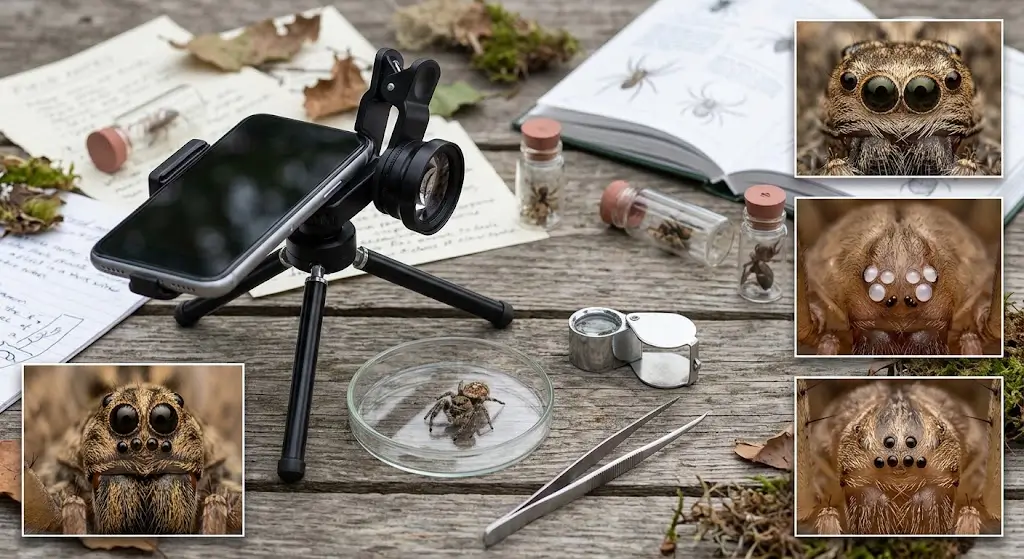
Wolf spiders (Lycosidae) have three rows with small eyes and large eyes, creating eye reflection with flashlight beams that can appear as green sparkles on the lawn at night.
The recluse group (Sicariidae) has six eyes in three pairs arranged in a semicircle, making it an unusual and diagnostic feature.
Eight small eyes that are evenly spaced often point to a web-builder like an orb weaver or cobweb spider.
Even specialists at the Burke Museum arachnology team note that trained beginners can make wrong identifications from published keys, and species-level identification may require a microscope and years of practice, so eyes help narrow the field rather than provide the final answer.
Step 4: Read the Web
A web can be more diagnostic than the spider itself, especially when the spider is hidden in the morning.
Different web types across the United States help with spider identification: an orb web has a classic wheel with radiating spokes and a sticky spiral, built by orb weavers (Araneidae), long-jawed orb weavers, and hackled orb weavers near garage doorways, shrubs, and porch lights, often rebuilt daily.
A tangle web or cobweb is a three-dimensional web with no obvious pattern, made by cobweb spiders (Theridiidae) like the American house spider and black widow, but a messy web in a corner does not always mean a widow.
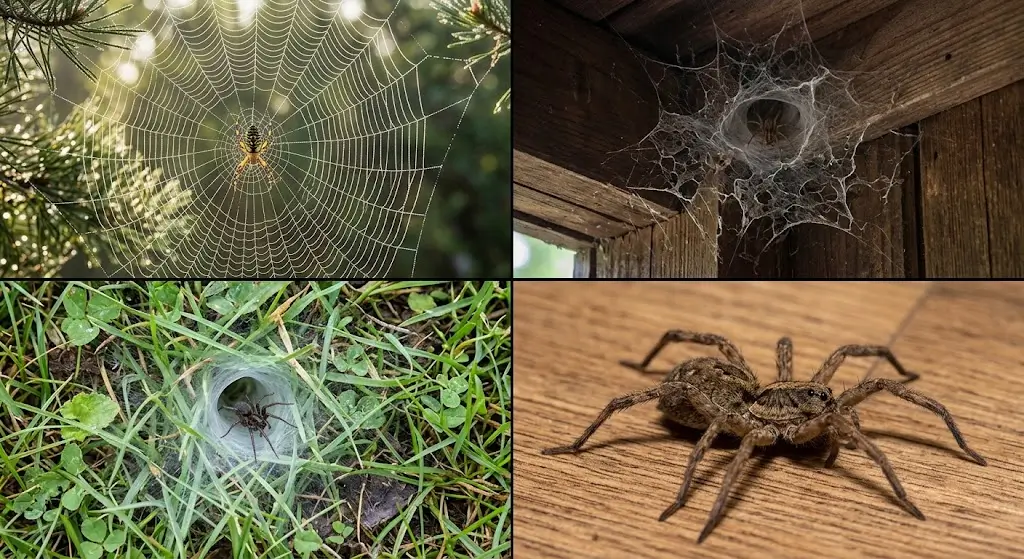
A funnel web is a flat sheet of silk leading into a tube, acting as a vibration alarm where the spider bolts when movement crosses it, common in lawns, ground cover, and foundation corners from grass spiders and hobo spiders.
A sheet web forms a dense flat mat or bowl-shaped mat between grass blades on dewy mornings, built by tiny money spiders (Linyphiidae). A retreat web is an irregular web hidden behind objects with little open space, used by recluses.
Some spiders have no web at all; wolf spiders, jumping spiders, crab spiders, and huntsman spiders are active hunters using silk for egg sacs and drag lines, not traps.
A big spider running across the floor is usually a hunter, and hunters are rarely dangerous spiders.
Step 5: Check Your Geography
This step often eliminates more wrong answers than appearance alone because range matters in identification. Brown recluses are native to the South and central Midwest, so reports from outside range are often misidentifications.
The Colorado State University Extension highlights that funnel weavers and wood louse hunters are commonly mistaken for recluses, while Michigan State extension gives similar cautions about local recluse bite news stories where no spider was collected.
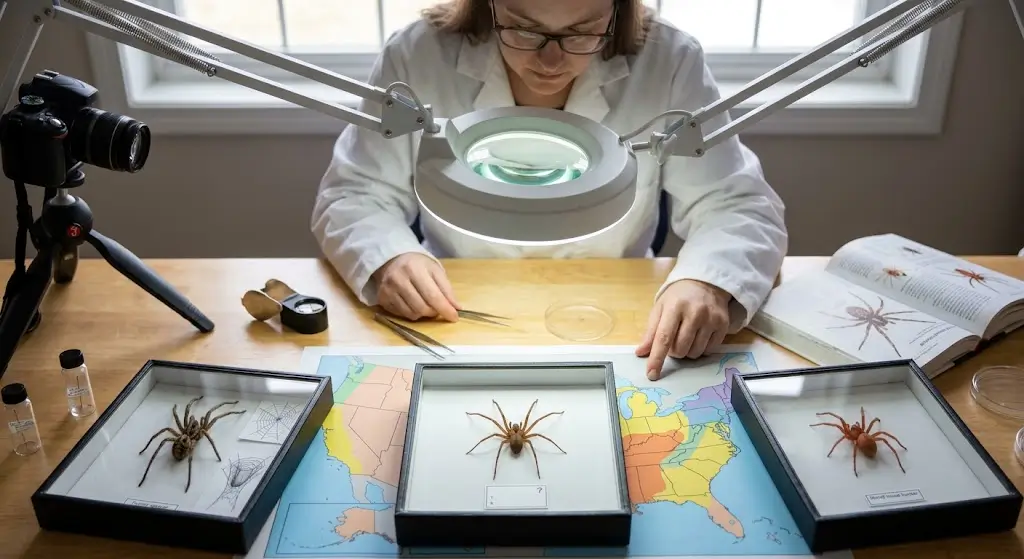
Always ask if the species actually live in your state because if the answer is no, the identification is probably wrong.
How to Identify Common Spiders in My House
Here are the eight you’re statistically most likely to meet indoors in the U.S.
| Spider | How to spot it | Web | Risk |
| American house spider | Small, dull brown-gray, round abdomen, mottled pattern | Messy cobweb in corners | Harmless |
| Cellar spider | Tiny body, absurdly long thin legs, vibrates when disturbed | Loose tangle in damp basements | Harmless |
| Jumping spider | Compact, fuzzy, often black with white or iridescent markings, hops | None | Harmless |
| Wolf spider | Large, hairy, brown with darker lengthwise stripes, fast, ground-level | None | Harmless (defensive bite only) |
| Grass / funnel weaver | Brown, long spinnerets visible at rear, very fast | Funnel sheet near foundations | Harmless |
| Hobo spider | Brown, chevron markings on abdomen, no leg bands, Pacific Northwest | Funnel | Overrated; not considered medically significant |
| Black widow | Glossy black, spherical abdomen, red hourglass underneath | Strong, irregular cobweb in sheds, woodpiles, meter boxes | Medically significant |
| Brown recluse | Uniform tan-brown, six eyes, violin mark, unbanded legs, uniform abdomen | Small hidden retreat web | Medically significant |
How to Tell If a Spider Is a Brown Recluse
The most useful trick for brown recluse identification is an inverted approach: instead of proving it is a recluse, use ruling-out criteria that non-experts can follow.
UC Riverside’s spider research program provides public guidance showing that banded legs, striped legs, anything beyond a uniform color abdomen with a single tone, spots, blotches, or patterning mean it is not a recluse.
True recluses have six eyes in three pairs, not eight eyes, have fine hairs instead of spines or thick spines, build hidden webs rather than a large web, open web, or conspicuous web, and are usually around 3/8 inch in body length (excluding legs).
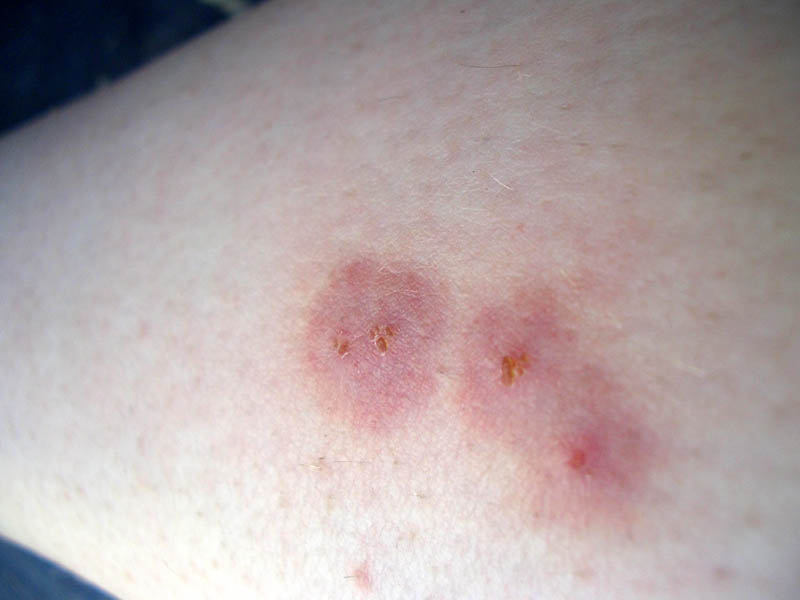
Even with an unknown spider, avoid wound self-diagnosis; spider bites are often misidentified in American medicine, and research in Clinical Infectious Diseases found presumed recluse bites in areas outside the correct spider range are frequently caused by other conditions like MRSA, Lyme disease, diabetic ulcers, and skin cancer.
If you have a spreading lesion, seek a doctor for proper medical evaluation rather than assuming a spider caused it.
How to Identify a Black Widow (and the Brown Widow Nobody Talks About)
A female black widow is usually glossy black or lacquered black with a spherical abdomen and a red hourglass or orange hourglass on the underside.
Her body size is around half an inch, with a leg span of about 1.5 inches to 2 inches, and she often hangs upside down in her web where the hourglass visible.
Northern black widows may show reddish triangles instead of a joined hourglass, along with red spots on the back. Males are smaller, slimmer, and longer-legged, and are generally not a concern.
The brown widow found across the southern U.S. is grayish to light brown with lateral striping and an orange hourglass.
The best spider identification clue is the egg sac: brown widows create spiky egg sacs covered with pointed silk spikes that look like a tiny sea mine, while other widow species make a smooth sac or round sac.
UC Riverside and invasive species researchers consider the egg sac the easiest way to separate species, especially around patio furniture, mailbox, or handrail areas.
How to Identify a Spider From a Photo
Modern identifications often start with a phone camera, using an AI identifier, iNaturalist, or BugGuide, but the real bottleneck is the photo itself.
Good spider observations need multiple photos instead of a single frame: take a top-down shot showing the cephalothorax, abdomen patterning, eyes, and eye arrangement, plus a wide shot of the location and habitat like a fence line, rosebush, or basement corner.
Include the web and a scale reference such as a coin, pen cap, or fingertip from a safe distance. Use natural light because shadows can hide segment borders and leg-proportion detail used by identification algorithms.
If possible, safely capture the underside through a glass jar or clear container to show a widow hourglass, but never risk a bite for a better angle.
A blurry photo with a state name is often more useful than a perfect photo without context.
What Most People Get Wrong
Myth: Spiders are easy to identify
- The Burke Museum arachnology team explains that family-level identification can be difficult, while species-level identification often needs a microscope and reference literature. Sometimes identifying it as an orb weaver is the most accurate result.
Myth: A skin bump means a spider bite
- A skin bump does not always mean a spider bite because most spiders cannot easily penetrate human skin unless they are pressed against the body inside clothing or bedding.
Myth: A messy web means a widow
- A messy web proves nothing because house spiders, false widows, and widow spiders all create irregular webs. The web alone cannot confirm identification.
Myth: Kill it because it does not matter
- A garage spider can help with natural pest control by eating mosquitoes, flies, and roaches. Proper identification often ends with choosing to leave it alone, making it the cheapest pest control available.
Frequently Asked Questions
When to Call Someone
Call a pest professional if you find multiple widow spiders or multiple spiky egg sacs around your home, especially if you are inside the recluse range and keep finding them repeatedly indoors.
If someone in the house has a bite with spreading pain, cramping, or a worsening lesion, seek a doctor for proper medical evaluation and differential diagnosis instead of assuming it is a spider bite.