How Long Do Praying Mantis Live
If you’ve ever encountered a praying mantis, you’ve probably noticed its distinct stance, with forelegs clasped as if in prayer, evoking the image of a soothsayer or prophet. These remarkable insects, often identified by their prominent front legs, go through a fascinating life cycle that begins with the egg stage, where the female mantis lays her ootheca. These egg cases remain dormant during winter, and by spring, the nymphs hatch, ready to begin their journey through life. As they grow and molt several times, they eventually reach the adult stage, where they no longer molt and begin mating.
The lifespan of a praying mantis can vary depending on factors like species and environmental conditions. In North America, the species can range from the green to the dull brown variety, with their life expectancy typically spanning from one month to six months in the wild. In captivity, however, mantises can live up to 1 year when provided with the right temperature, humidity, and regular meals of insects.
While their life span may be shorter in the wild due to predators like birds and frogs, species in colder climates may experience even shorter lifespans due to harsher conditions. On the other hand, those in warm, sunny environments tend to thrive and survive longer. The average lifespan in nature tends to be shorter, especially when facing diseases, parasites, and the constant challenges of food scarcity.
So, whether in wild or captivity, a praying mantis typically lives between 6 months to a year, depending on its species, care, and the environment it’s in. These tiny creatures truly live an intriguing and unique life, continuing to captivate us with their distinct behavior and their role in nature’s cycle.
How Long Does the Average Praying Mantis Live?
The average lifespan of a praying mantis varies based on species, but most smaller species live between 4 to 8 weeks, while larger species can survive for 4 to 6 months. In captivity, some mantises may live up to 18 months, but in the wild, their life expectancy is usually much shorter, often only a month to six months depending on species and size.

Females tend to outlive the males, as seen in studies like those from the Journal of Entomology where the European mantis had males living an average of 165 days and females surviving for 196 days. A pet mantis, when properly cared for, may outlive its wild counterparts by a substantial amount of time, thanks to stable conditions and the absence of predators.
Their life cycle is interesting, as females lay a dozen to a hundred eggs in egg cases or ootheca, which overwinter until the nymphs hatch in spring. These nymphs undergo incomplete metamorphosis, continuing to develop through various stages until they reach the adult stage, ready to mate, thus restarting the cycle.
What Do Praying Mantises Eat?
As impressive predators, praying mantises have a wide variety of prey they’ll eat, including insects like crickets, flies, moths, and even pests such as the brown marmorated stink bug. While they’re often considered beneficial insects in the garden, helping to keep pest populations in check, mantises don’t differentiate between pests and other kind insects. In fact, the female praying mantis is known to decapitate and eat her mate after, or even during mating, which is a true testament to their predatory nature.
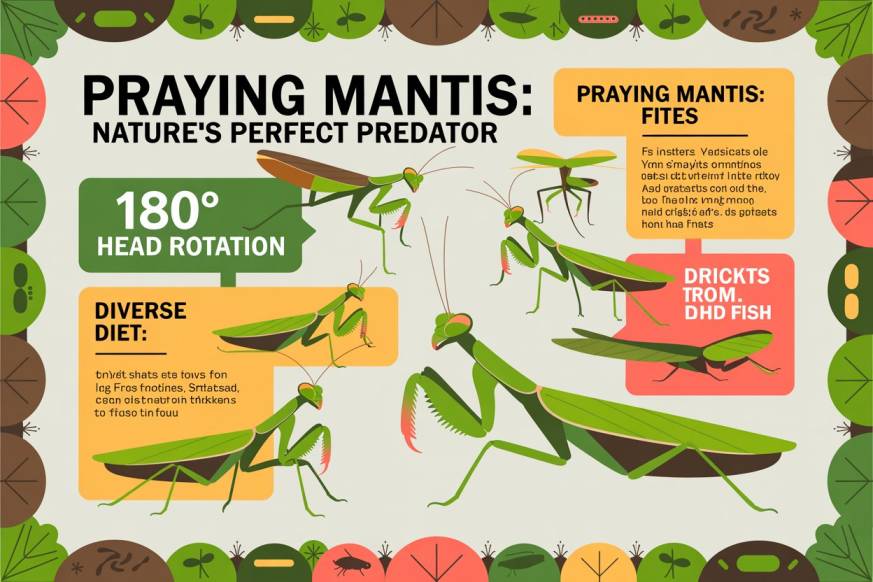
With their ability to turn their head a full 180 degrees, thanks to their compound eyes on their triangular head, and the simple eyes behind it, mantises are well-equipped for spotting prey. Their front legs are armed with spikes, which help them grab prey and strike with precision. Not only do they catch and kill common garden pests, but they’ve even been known to eat live prey like guppy fish. This diverse diet is one of the key traits that make them such fascinating predators.
The Life Cycle of the Praying Mantis
The life cycle of a praying mantis unfolds in three distinct stages: egg, nymph, and adult. After mating, the female praying mantis lays her eggs in an ootheca, where they remain dormant throughout the winter. Come spring, the nymphs hatch and start their journey, beginning as miniature versions of adults. As they grow, they molt several times, shedding their exoskeleton to accommodate their increasing size.
By the time they reach the adult stage, they no longer molt and begin the process of mating to start the cycle anew. Over the course of their life span, they undergo significant changes in size and development, with some mantises living just a few months in the wild or up to a year in captivity, depending on species and environmental conditions.
Egg
The adult female praying mantis lays between 100 to 400 eggs in a protective sac known as an ootheca, which is carefully placed on a sturdy leaf or stem. This liquid coating hardens over time, forming a robust protective case capable of withstanding major weather fluctuations. The ootheca serves as a safe environment where the eggs remain dormant throughout the winter, waiting for the right conditions to hatch.
As mid-spring approaches and temperatures rise, the egg casings begin to crack, and nymphs emerge, ready to begin their next life stage. This stage sets the foundation for the mantis’s entire life cycle.
Nymph
The newly born nymphs emerge from the egg casing and immediately begin their journey through life. These tiny mantis nymphs will feed on their newly hatched siblings and forage for small insects, such as fruit flies. As they continue their development, the nymphs go through several phases, known as instars, where they molt and grow, shedding their exoskeleton each time to allow for the development of new body segments and larger body size.
They may molt five to ten times before reaching the next stage of life, and during this time, they are at risk of being preyed upon by huge predators like bats, birds, and spiders. Not all nymphs survive this critical stage, but those that do continue to grow and mature into adulthood.
Adult
Full-grown mantises can range in length from one to six inches, and their size varies depending on the species. They have a distinct physical structure common to most insects, with a head, abdomen, and thorax. Female mantises are often identifiable from males due to their larger abdomens.
As a carnivorous bug, the diet of a praying mantis is diverse, feeding on small insects, as well as nesting birds, mice, lizards, and tree frogs. Females are also known to feast on the head of the male mantis during or after mating, before laying eggs. After laying eggs, the female mantis typically dies, completing its life cycle.
Where Do Praying Mantises Live?
Praying mantises are ambush predators commonly found in vegetation, where they can easily blend into their plant surroundings. With over 2,000 species worldwide, about 20 species are found in the United States, with a few being more common than others. These remarkable insects can often be found in gardens, where they reduce harmful pests. They are sometimes even studied in classrooms or released into gardens to help manage pest populations.

Egg cases can be collected indoors without harming the mantises inside. Once hatching occurs, the newly born mantises begin their life cycle. Some people use simple tools like a milk carton or a fish aquarium to create a habitat for mantises, offering them an unobstructed view for observation, as recommended by the Oregon State Extension guide.
What Affects the Praying Mantis’ Lifespan?
The life expectancy of a praying mantis is influenced by several factors, such as the availability and quality of food. Mantises that have access to high-quality food are more likely to grow and reach their full size. Whether a mantis is kept as a pet or is living in the wild also plays a significant role in its lifespan.
In captivity, mantises often live longer because they are protected from natural predators and don’t have to hunt for food, unlike those in the wild, where food scarcity and predation can shorten their lifespan.
Tips for Maximizing Your Praying Mantis’ Lifespan
Provide a suitable tank: As a pet owner, to maximize lifespan, keep your mantids in a tank where they won’t be exposed to cannibalism by other mantids of the same species.
Maintain proper temperature and humidity: Ensure the temperature and humidity levels match the species’ needs, whether they thrive in humid woodland environments, deserts, or dry grasslands.
Feed them properly: Offer a variety of live prey such as flies, crickets, moths, caterpillars, and locusts to meet their dietary needs. The food should match the species, keeping in mind their bodily state, whether they are well-fed or lean.
Control feeding frequency: Depending on the mantis’ size and life stage, decide how often to feed them. Some mantises may need daily feedings, while others may require less frequent feedings to avoid overfeeding and ensure healthy growth.
What Is The Difference Between A Chinese Mantis And A Praying Mantis?
| Feature | Chinese Mantis | Praying Mantis (Carolina Mantis) |
|---|---|---|
| Origin | Native to Asia, introduced to the US | Native to the southeastern United States |
| Size | Up to 5 inches long | Up to 3 inches long |
| Aggressiveness | Highly aggressive predator | Less aggressive |
| Diet | Wasps, mosquitoes, flies, small mantis, reptiles, amphibians, hummingbirds | Common garden pests |
| Role in Gardens | Controls pests but may harm native species | Helps maintain ecological balance |
| Predatory Skill | Very strong, dominant hunter | Moderate predator |
| Egg Case Appearance | Tan, looks like toasted marshmallows | Smaller, smooth with brown stripes |
| Conservation Impact | Can disrupt native mantis populations | Encouraged by conservationists |
Chinese Mantis
The Chinese mantis, a beneficial insect originally from Asia, has gained attention in the US due to its accidental introduction. It is much larger than the Carolina mantis, with the Chinese mantis reaching up to five inches. The Chinese mantis is known for its voracious appetites, preying on garden pests like wasps, mosquitoes, and flies.
The Chinese mantis has a greater predatory skill and can sometimes even eat smaller Carolina mantis and other creatures like reptiles, amphibians, and hummingbirds. Its egg cases are described as resembling tan toasted marshmallows.
Praying Mantis
The praying mantis generally refers to various species of mantids that play a crucial role in controlling pests in gardens. Unlike the Chinese mantis, the Carolina mantis is a native species in the Southeast and tends to be smaller, typically reaching only three inches. Both species help manage pests but the Carolina mantis is less aggressive than its Chinese counterpart.
The Carolina mantis’ egg cases are smaller, with a smooth surface and brown stripes. This species has been a key beneficial insect in reducing pest populations, and many conservationists encourage its presence in gardens to maintain ecological balance.